
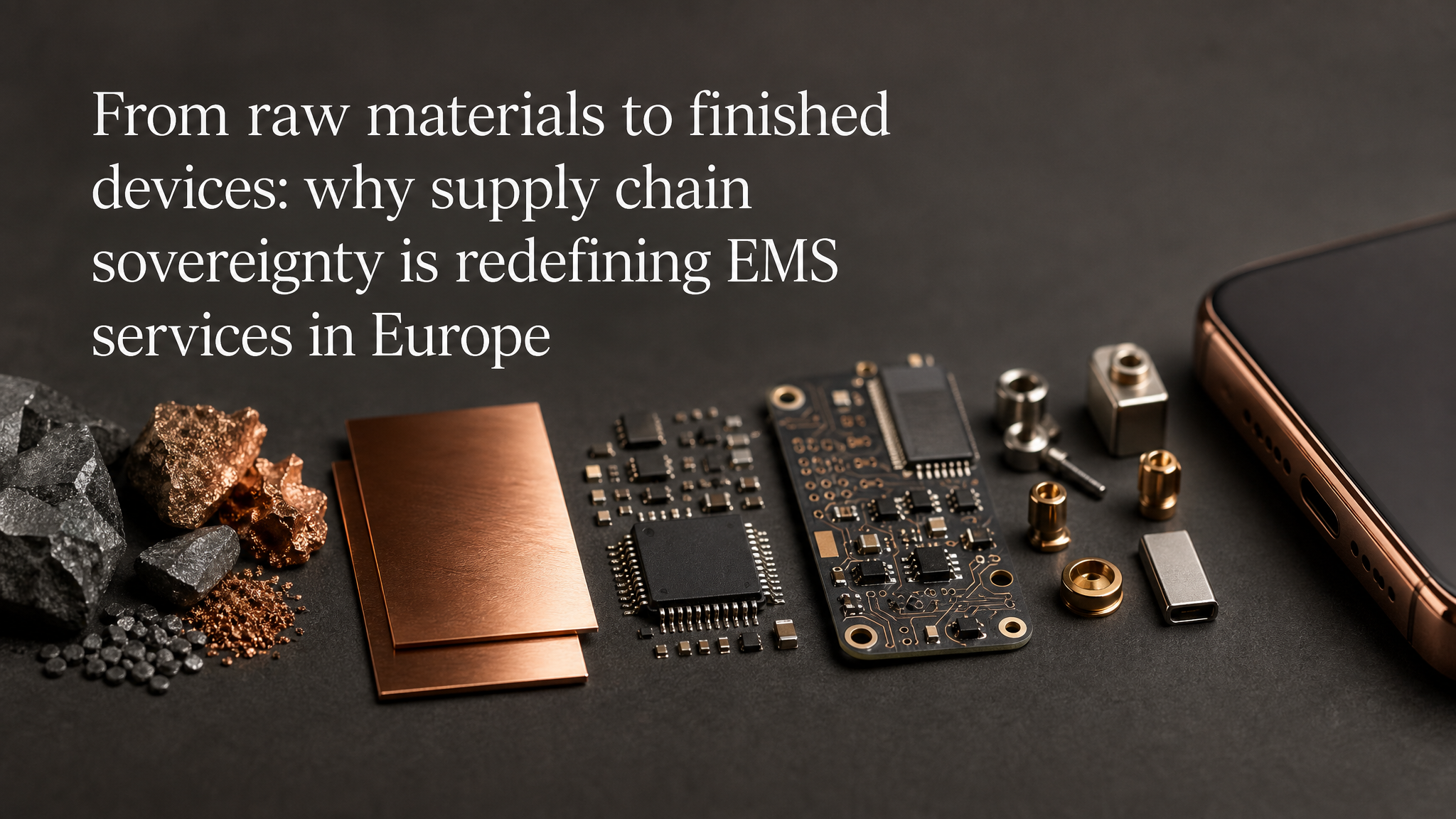
As geopolitical tensions intensify, critical metal prices remain volatile, and supply chains continue to regionalize, Europe faces a growing challenge: how to secure real technological sovereignty. These shifts are transforming the electronics manufacturing services (EMS) sector and forcing companies to rethink how they select suppliers, components, and manufacturing partners. In this environment, resilience, traceability, and strategic independence are no longer optional. They are becoming essential to competitiveness, continuity, and economic security.
Introduction to technological sovereignty
Current geopolitical challenges
The global geopolitical environment has become significantly more unstable in recent years. Rising protectionism, trade restrictions, strategic rivalry between major powers, and regional conflicts are all affecting the flow of components, raw materials, and technologies. For companies in Poland and across Europe, these developments are no longer abstract political issues. They translate directly into delayed shipments, higher procurement risk, longer lead times, and growing uncertainty in production planning.
In this context, technological sovereignty is gaining strategic importance. It can be understood as the ability of a country, an economy, or an industrial ecosystem to develop, produce, and deploy key technologies without excessive dependence on external actors. For Europe, that means reducing exposure to non-EU suppliers in critical areas and building stronger domestic and regional capabilities. This is not only an economic issue, but also a matter of resilience, public-sector reliability, and long-term security.
Volatility in critical metal prices
The availability and pricing of critical metals such as lithium, cobalt, and nickel have become a major source of pressure for modern industry. These raw materials are essential to the production of advanced electronics, batteries, energy systems, and many industrial applications. Because they are often extracted or processed in politically sensitive regions, their supply is vulnerable to disruption, speculation, and sudden price swings.
For manufacturers, this creates a double challenge. On one hand, costs become harder to predict. On the other, long-term sourcing becomes less secure. Companies that want to remain competitive need procurement strategies that go beyond price alone. They need reliable supplier networks, stronger visibility into sourcing risks, and product strategies that reduce vulnerability to raw material shocks. In many cases, that also means investing in more flexible engineering, substitution planning, and regional sourcing models.
Regionalization of supply chains and reshoring
Regionalization is becoming one of the defining trends in European industry. After years of relying heavily on distant production hubs and globalized logistics networks, many companies are now moving parts of their supply chain closer to home. This process, often referred to as reshoring or nearshoring, is driven by the need to improve control, reduce disruption risk, and shorten response times.
For Europe, this shift brings strategic advantages. Regional supply networks are generally more transparent, easier to coordinate, and better aligned with regulatory and quality standards. They also support the growth of local industrial ecosystems and create new opportunities for small and medium-sized enterprises. In the EMS sector, regionalization strengthens resilience by reducing dependence on distant suppliers and by making production planning more predictable in times of global instability.
The socio-economic challenge in the EMS sector
Supply partner security
In the EMS sector, the choice of supply and manufacturing partners has become a strategic decision rather than a purely operational one. Original equipment manufacturers are increasingly looking for partners that can offer not only cost efficiency, but also continuity, flexibility, and reliability under pressure. Overdependence on a single supplier or a single sourcing region is now seen as a serious business risk.
This is changing the logic of industrial cooperation. Today, the strongest partnerships are built not only around price and capacity, but around resilience. Companies want partners that can respond quickly to shortages, identify alternative components, and support continuity even when global conditions deteriorate. In this sense, supply partner security becomes part of a broader sovereignty strategy. It helps businesses protect production, safeguard delivery commitments, and reduce exposure to external shocks.
The risk of import disruptions from Asia
For many EMS companies in Europe, dependence on Asian imports remains one of the biggest structural vulnerabilities. Long supply lines, complex logistics chains, and heavy reliance on overseas component manufacturing create systemic risk. Even minor disruptions in ports, transport corridors, customs procedures, or local production hubs can quickly affect European operations.
The past few years have shown how fragile this model can be. Pandemic-related shutdowns, geopolitical tensions, shipping bottlenecks, and export restrictions exposed the weaknesses of supply chains optimized primarily for cost. When critical components become unavailable, manufacturers face production stoppages, delayed launches, contract pressure, and reputational risk. This is one of the strongest arguments for developing alternative sourcing strategies and stronger regional manufacturing ecosystems.
The search for alternative sources
As risk awareness grows, EMS companies are actively diversifying their supplier base and looking for alternative sources of components and materials. This is not simply a procurement adjustment. It is a strategic transformation of how manufacturing resilience is built.
Alternative sourcing may include second-source qualification, component redesign, supplier diversification, regional procurement, or deeper collaboration with engineering teams to validate replacements. The goal is to reduce dependence on fragile supply routes and increase the ability to respond quickly when disruption occurs. In Poland and across Europe, this also creates room for the development of stronger local industrial networks that can support both innovation and production security.
New electronics technologies and sovereignty
Conscious selection of components and substitutes
A more sovereign electronics strategy starts with more conscious component selection. In the past, many sourcing decisions were driven mainly by availability and price. Today, companies increasingly need to assess broader risk factors, including geographic exposure, lifecycle stability, market concentration, compliance requirements, and substitution potential.
For EMS providers, this means playing a much more active role in the value chain. Instead of simply assembling a fixed bill of materials, they are expected to help customers make better technical and strategic choices. That includes identifying approved alternatives, assessing cross-compatibility, monitoring market availability, and minimizing dependency on vulnerable suppliers. The result is a more resilient product architecture and a stronger ability to keep production moving under difficult conditions.
Designing with raw material availability in mind
Product design is becoming a key lever in supply chain resilience. If a product is designed around hard-to-source materials or highly concentrated component categories, it becomes more vulnerable from the very beginning. That is why forward-looking companies are increasingly designing with material availability, lifecycle stability, and substitution flexibility in mind.
This approach often overlaps with circular design principles. Engineers and manufacturers are looking more carefully at the full lifecycle of a product, from sourcing and production to repairability, reuse, and end-of-life considerations. Designing for resilience does not only reduce risk. It can also improve sustainability, lower long-term cost volatility, and strengthen alignment with European industrial and environmental priorities.
Innovation in the digital sector
Technological sovereignty in electronics is closely linked to digital sovereignty. Control over hardware manufacturing is important, but so is control over data, software, digital infrastructure, and cybersecurity capabilities. Europe’s ability to build independent and secure digital systems will increasingly influence the competitiveness of its manufacturing base.
That is why investment in advanced software, secure ICT infrastructure, industrial automation, data management, and open technological ecosystems is so important. Companies that combine hardware strength with digital capability are better positioned to adapt, optimize supply chains, and maintain control over critical operations. In the EMS sector, digital tools also improve traceability, planning accuracy, quality assurance, and supply chain visibility, all of which support a more autonomous industrial model.
Applications in EMS and benefits for customers
Comprehensive support in selecting component alternatives
Working with an experienced EMS partner today means far more than outsourcing PCB assembly or final device production. One of the most valuable benefits is access to engineering support in the selection of component alternatives. In a volatile market, the ability to identify, validate, and implement suitable replacements can determine whether production continues or stops.
A strong EMS partner helps customers assess technical compatibility, supply risk, lifecycle factors, and long-term availability. This reduces dependence on single-source components and increases product resilience without compromising quality or performance. For OEMs, this kind of support can significantly shorten decision-making time and improve continuity in periods of market stress.
Testing and quality assurance
Quality assurance becomes even more important when supply risk is high and component substitutions are sometimes necessary. In this environment, robust testing is not just a quality function. It is a critical risk-management tool. Manufacturers must be confident that substituted or requalified parts will perform correctly in real operating conditions.
That is why advanced EMS providers invest in comprehensive testing processes that go beyond basic inspection. Functional testing, process verification, traceability, and quality monitoring all help ensure that the final product meets technical, regulatory, and operational requirements. High testing discipline also protects customers against hidden failures, field issues, and the downstream costs of quality problems.
On-time product readiness
In an unstable market, on-time readiness is one of the clearest indicators of operational strength. Delays in sourcing, poor communication with suppliers, and weak planning processes can easily derail production schedules. Customers increasingly expect their EMS partners to manage these risks proactively and deliver reliable production outcomes despite external pressure.
This requires more than purchasing efficiency. It requires strong planning, trusted distributor relationships, inventory strategy, engineering support, and real-time responsiveness. An experienced EMS partner can coordinate these moving parts more effectively, helping customers protect launch timelines, fulfill contracts, and maintain credibility with their own markets.
Why supply chain sovereignty matters for EMS customers
Better resilience in uncertain markets
For customers, supply chain sovereignty is not an abstract policy concept. It has direct operational value. A more sovereign and regionally anchored manufacturing model means fewer surprises, faster response to disruptions, and stronger continuity in volatile conditions.
When sourcing is better diversified and manufacturing is supported by regional competence, customers gain a more stable foundation for product development and business growth. That stability is increasingly valuable in sectors where downtime, redesign, or missed deadlines can have major commercial consequences.
Stronger control over quality and compliance
Local and regional manufacturing partnerships usually make it easier to maintain visibility and control. Communication is faster, audits are easier, standards are clearer, and corrective actions can be implemented more efficiently. This is especially important in sectors with strict quality, documentation, or regulatory requirements.
For customers operating in demanding industries, closer cooperation with a reliable European EMS partner can improve both compliance confidence and product consistency. That translates into lower operational risk and better long-term predictability.
Greater strategic flexibility
Markets change quickly, and supply chains need to adapt just as fast. Customers that work with capable EMS partners gain strategic flexibility because they are not locked into a rigid sourcing model. They can respond more effectively to market shortages, demand fluctuations, engineering updates, and geopolitical disruption.
This flexibility supports smarter growth. Instead of being forced into reactive crisis management, companies can make deliberate decisions about sourcing, design, and manufacturing with a clearer understanding of risk.
TSTRONIC as a stable manufacturing partner
Access to trusted distributors
TSTRONIC offers customers access to a network of trusted electronic component distributors built through long-term market experience and strong supplier relationships. In a period of shortages, allocation pressure, and sourcing uncertainty, those relationships matter. They support continuity, improve transparency, and help reduce the risk associated with overdependence on unstable or poorly verified channels.
For customers, this means more secure procurement and better production planning. Instead of constantly reacting to market volatility, they can build their projects on a more stable sourcing foundation.
Modern assembly lines and quality standards
TSTRONIC’s production capabilities are based on modern assembly infrastructure and rigorous quality standards designed to support complex, high-reliability projects. Advanced manufacturing lines, process discipline, and continuous improvement create an environment where efficiency and quality can go hand in hand.
This matters not only for today’s production requirements, but also for long-term industrial resilience. Customers need partners that can scale, adapt, and maintain high standards even in demanding market conditions. Strong manufacturing capability is a key part of that trust.
A partner for a more resilient EMS future
The European EMS sector is evolving quickly, and companies that want to remain competitive need partners that understand both technology and risk. Supply chain sovereignty is no longer a niche topic. It is becoming central to how electronics products are designed, sourced, manufactured, and delivered.
TSTRONIC supports this shift by combining manufacturing capability with engineering know-how, sourcing awareness, and a commitment to long-term reliability. For companies looking to strengthen resilience, improve production security, and reduce supply chain vulnerability, choosing the right EMS partner is now a strategic decision.

