
Turnkey vs consignment vs hybrid – which EMS collaboration model to choose?
Choosing the right collaboration model with an EMS (Electronic Manufacturing Services) provider is a strategically important decision for every OEM manufacturer, affecting production costs, process control, and speed of new product introduction. This article compares three main models: Turnkey, Consignment, and Hybrid, to help you make the optimal decision in the context of industrial electronics assembly.
Introduction to EMS collaboration models
Modern electronics production, including SMT and THT assembly, requires flexibility and precision, which is why choosing the right collaboration model with an EMS service provider is crucial for achieving market success. Understanding the specifics of each model – Turnkey, Consignment, and Hybrid – allows for supply chain optimization and risk minimization, which directly translates to the competitiveness of an electronic product on the market.
Definition of models: Turnkey, consignment and hybrid
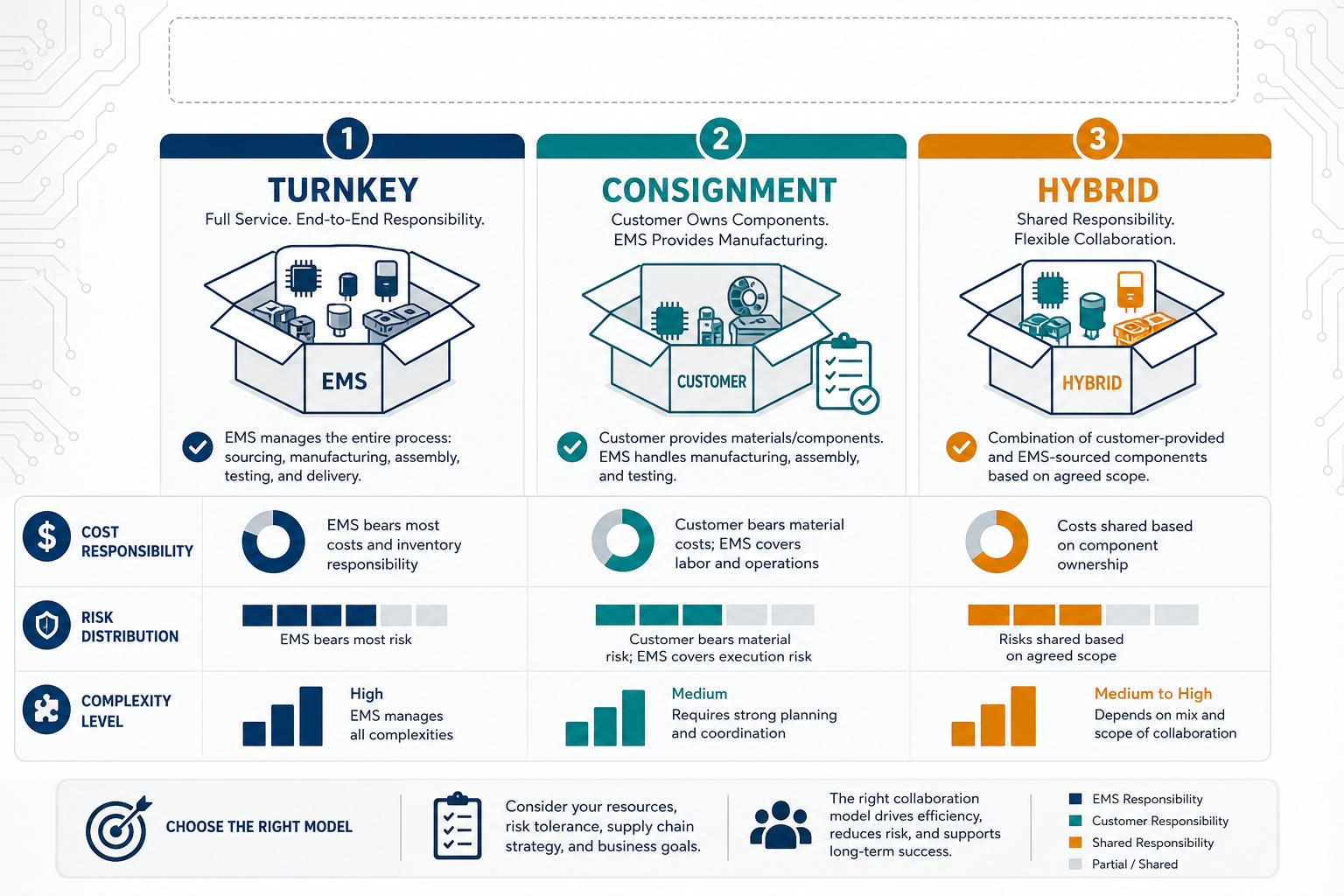
The Turnkey model, also known as full-service, is a comprehensive approach to electronics production, including surface mount assembly and THT technology. It is a comprehensive service package where the EMS provider is responsible for the entire production process, from ordering components, through SMT and THT electronics assembly, to testing and logistics of the finished product. In the Consignment model, the OEM independently manages the component supply chain, delivering them to the EMS facility, which then only provides PCB assembly services. The Hybrid model combines both approaches, where some components are managed by the OEM and some by the EMS service provider, allowing for greater flexibility.
Advantages and disadvantages of each model
The Turnkey model offers the OEM significant reduction in operational burden, minimizing the need to manage a complex supply chain, which translates to time and resource savings, but it comes with potentially higher production costs. Consignment, on the other hand, provides greater control over component sourcing and often lower direct costs, which is particularly important in the context of PCB technology, however, it requires the OEM to be involved in inventory management and the risk associated with their availability. The Hybrid model, being a compromise, allows for balancing control and costs, but may introduce additional complexity in coordination.
Why is model selection crucial for electronics production?
Choosing the right collaboration model with an EMS service provider is fundamentally important for timeliness, reliability, and overall electronics production costs, including costs related to assembly technology. Parameters such as circuit complexity, component availability on the market, required level of process control, and the OEM’s internal technical competencies – all these factors influence the decision on assembly technology selection. The optimal collaboration model guarantees not only efficient assembly of electronic components but also supports achieving competitive advantage in the market through cost optimization and time-to-market.
Cost comparison of collaboration models
Cost analysis of Turnkey
The Turnkey model, characterized by a comprehensive approach to production, usually involves higher initial costs for the OEM, but offers significant benefits in the long-term perspective. The EMS service provider, assuming full responsibility for the component supply chain, SMT and THT assembly, testing, and logistics, often obtains better prices from their suppliers thanks to economies of scale. This translates into material cost optimization, which can ultimately offset seemingly higher service fees, while providing high reliability of the production process.
Costs associated with the consignment model
In the consignment model, the OEM bears direct responsibility for component purchase costs, which may seem attractive due to the possibility of direct price negotiation. However, additional expenses related to supply chain management should be taken into account, including warehousing costs, logistics, as well as the risk of obsolete inventory or quality issues with delivered components. In this model, the EMS service provider focuses exclusively on electronics assembly, which reduces their margin for services but increases the OEM’s operational burden, affecting overall production costs.
Expenses in the hybrid model
The hybrid model represents a balanced approach that can contribute to cost optimization, combining the advantages of Turnkey and Consignment models. The OEM may decide to independently manage the purchase of critical components or those that are available at more favorable prices, while the EMS service provider will handle the rest of the supply chain and comprehensive electronics assembly, including SMT and THT assembly. This solution allows for flexible management of risk and costs, adapting them to the specifics of a given project and the current situation on the electronic component market, which is crucial for efficient production.
Control and risk in different collaboration models
How does quality control differ in each model?
In the Turnkey model, the EMS service provider offers full service in the area of assembly technology, which increases production efficiency. The EMS service provider bears full responsibility for quality control at every stage of the production process, from component verification to final testing of the finished electronic product, including assembly using SMT technology. The OEM has less direct control over individual operations, such as SMT assembly or THT assembly, but relies on proven procedures and supplier certifications, which ensures high reliability of electronics production. In the Consignment model, quality control is divided – the OEM is responsible for the quality of delivered components, while the EMS service provider is responsible for assembly quality and production processes, including SMT technology. The Hybrid model offers a flexible approach, where the OEM and EMS jointly agree on the scope of responsibility for quality control, allowing for optimization of supervision over individual stages of PCB assembly and other electronics production processes.
Identifying risks associated with each model
The Turnkey model minimizes operational risk for the OEM by transferring it to the EMS service provider, who is responsible for the entire supply chain and assembly of electronic components, including SMT and THT assembly. The risk is mainly related to dependence on a single supplier. In the Consignment model, the OEM bears the risk associated with availability, quality, and component management, which can lead to production delays or cost increases if components prove defective or unavailable. The Hybrid model carries risks associated with the division of responsibility, which can lead to ambiguity in case of quality or availability issues, requiring precise definition of roles and responsibilities in the contract.
Risk minimization strategies in electronics production
To minimize risk in the Turnkey model, it is crucial to select a reputable EMS service provider that holds quality certifications and documented experience in electronics production and offers comprehensive testing. In the Consignment model, the OEM should implement rigorous supplier quality control procedures and have a contingency plan in case of their unavailability. For the Hybrid model, it is essential to precisely define the scope of responsibility of each party in the agreement, including component management procedures and quality control protocols at every stage of SMT and THT electronics assembly. Regardless of the chosen model, regular communication and supplier audits are crucial for ensuring reliability and timeliness of production.
Speed of implementation of collaboration models
How quickly can the Turnkey model be implemented?
Implementation of the Turnkey model is usually the fastest from the OEM’s perspective, because the EMS service provider, having developed supply chains and comprehensive manufacturing capabilities, can immediately proceed with electronics assembly using SMT technology. The OEM limits its involvement to providing product specifications and monitoring progress, which accelerates the entire process from concept to finished product. Because the EMS provider manages all aspects, from component purchasing through SMT and THT assembly to testing, the product time-to-market is significantly shortened, which is crucial in the dynamic electronics industry.
Implementation speed in the consignment model
In the Consignment model, the speed of project implementation largely depends on the OEM’s efficiency in managing and delivering components to the EMS service provider. If the OEM has an optimized supply chain and quickly delivers all necessary electronic components, SMT and THT assembly can proceed very smoothly. Delays in component deliveries or their insufficient quality, however, can significantly extend the project implementation time, which directly affects production timeliness and product availability on the market. Efficient component logistics is key here for maintaining continuity of the electronics assembly process.
Implementation efficiency in the hybrid model
The Hybrid model offers a balanced approach to implementation speed, allowing for flexible time management. The OEM can accelerate the process by entrusting the EMS service provider with the management of the most complex or hard-to-obtain components, which shortens the time needed to acquire them. At the same time, independent management of part of the supply chain allows for maintaining control over the schedule for critical elements, such as PCBs. Implementation efficiency in this model depends on precise division of responsibilities and smooth communication between the OEM and the EMS service provider to ensure continuity and timeliness of all production stages, from component purchasing to SMT and THT assembly.
Recommendations for OEMs when choosing a collaboration model
What factors to consider when choosing an EMS service provider?
Choosing an EMS service provider and collaboration model is a strategic decision that should take into account a number of key factors. First and foremost, the complexity and uniqueness of the project, electronic component availability on the market, and the required level of control over the entire electronics production process, including SMT and THT assembly, should be evaluated. The OEM’s internal technical competencies, their experience in supply chain management, and expected product time-to-market are also important. Analysis of these parameters will allow for choosing a collaboration model that best suits the project specifics and business objectives, including production technologies.
Examples of model applications in the electronics industry
In the electronics industry, each collaboration model with an EMS service provider finds its specific application. The Turnkey model is often chosen by startups or companies that do not have their own extensive resources for supply chain management and production, valuing the comprehensive approach and speed of implementation. Consignment is suitable for OEMs that have a strong negotiating position with component suppliers and want to maintain full control over their purchases. The Hybrid model is ideal for medium and large enterprises that want to optimize costs and risk by dividing responsibility for the supply chain and SMT and THT assembly depending on project specifics and electronic component availability.
Summary and recommendations for different types of OEMs
To summarize, recommendations for different types of OEMs are closely linked to their specific needs and resources in the area of production technologies. For companies with limited infrastructure and resources, the Turnkey model offers the greatest convenience and efficiency in electronic component assembly in the context of implementation speed and risk minimization. OEMs with developed procurement departments and supply chain management experience will find the Consignment model more advantageous in terms of cost control and electronic component delivery. The Hybrid model is the most versatile, allowing for flexible adjustment of service scope to changing needs and market conditions, making it an optimal choice for many electronics manufacturers seeking a balance between control and efficiency.
Summary
Key conclusions from model comparison
Analysis of collaboration models – Turnkey, Consignment, and Hybrid – clearly shows that each offers a unique set of advantages and disadvantages that must be carefully considered in the context of project specifics and OEM capabilities. Key conclusions emphasize that the Turnkey model provides the greatest convenience and speed of implementation, but involves less control and potentially higher costs related to THT technology. Consignment offers greater control and the possibility of component cost optimization, but increases the OEM’s operational burden. The Hybrid model is a flexible compromise, allowing for adjustment of responsibility scope for the supply chain and SMT and THT electronics assembly.
How to find the best EMS service company?
To find the best company offering EMS services, conducting an in-depth analysis of potential partners is crucial. Attention should be paid to the supplier’s experience in electronics production, their manufacturing capabilities, quality certifications held, and references from other clients. It is important that the EMS service provider has modern production lines for SMT and THT assembly, as well as offers comprehensive testing services. Open communication and flexibility in adapting to changing project needs are also important, which is particularly important when choosing the optimal collaboration model.
CTA: Consult the collaboration model for your product
Choosing the right collaboration model with an EMS service provider is a decision of fundamental importance for the success of your electronic product. If you need support in analyzing which of the models – Turnkey, Consignment, or Hybrid – best meets your needs, contact us. Our experts will help you evaluate production costs, risks, level of control, and implementation speed, so you can make the optimal decision. Consult the collaboration model for your product today and optimize your electronics assembly process, ensuring its timeliness and high quality.

